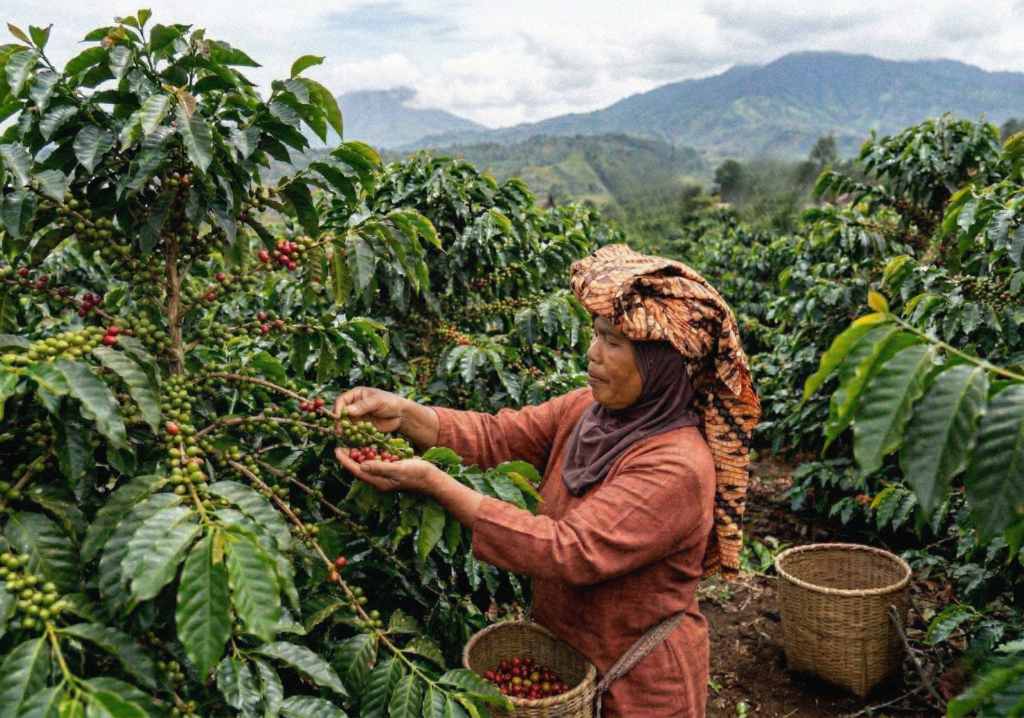

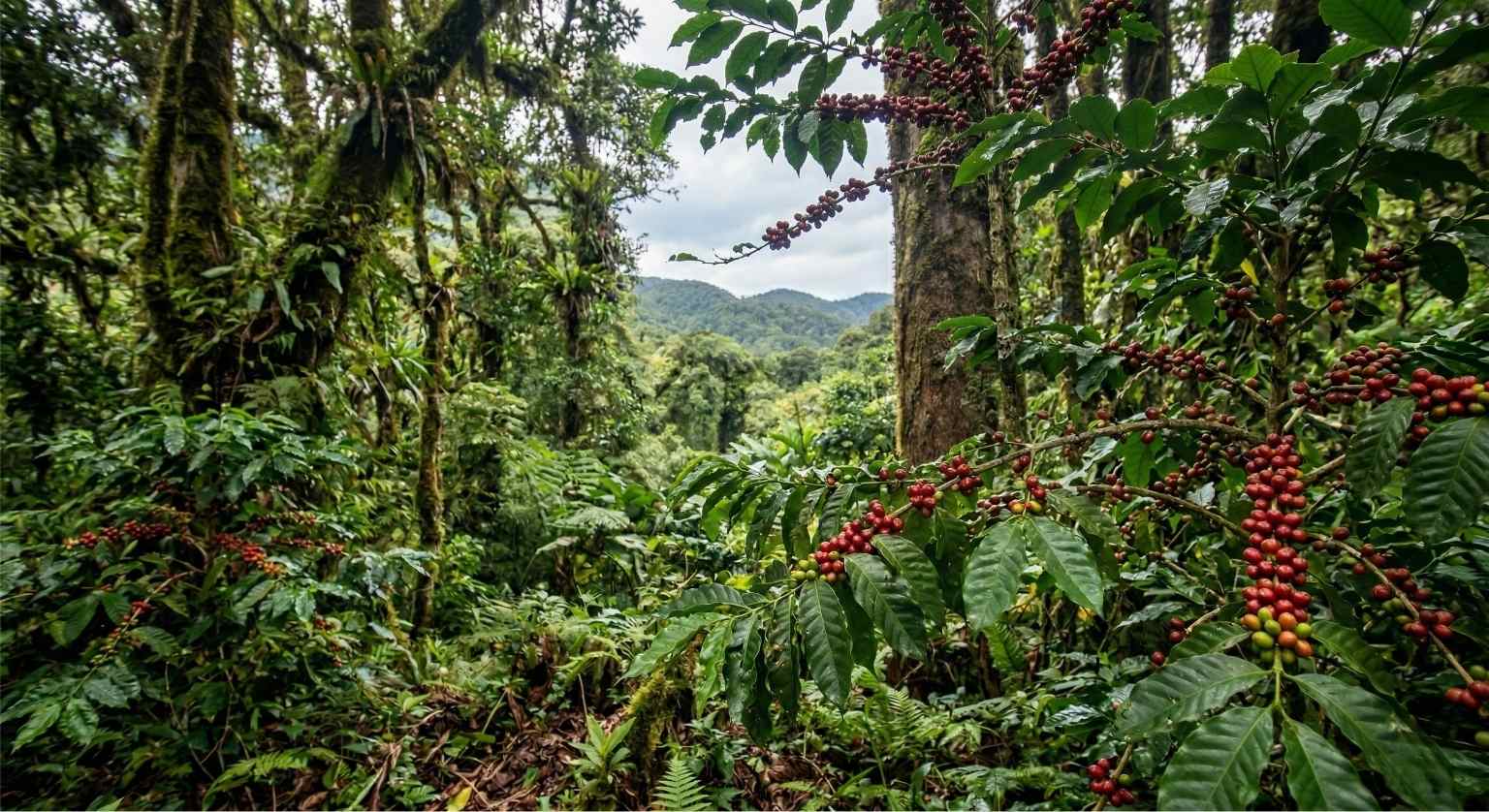
The morning mist still hung heavily, blanketing the tree canopies in the agroforestry ecosystem that directly borders the secondary forests of Dispot Linge and Kepala Akal villages. In the biting chill of the dawn air, Pak Hasan, a third-generation coffee farmer, pulled his jacket tighter. His sharp eyes gazed upward, tracing the gaps in the canopy of the coffee shade trees. For him, this forest is not merely agricultural land; it is an ecological theater where a biochemical miracle takes place every single night.
As the primary supplier for Lamoncecoffee.com, Pak Hasan carries a duty far more complex than that of a conventional coffee farmer. He is a hunter of “green gold”—the droppings of the wild civet that harbor the most exclusive coffee beans in the world.
The Nocturnal Harvester in the Dark
To understand the immense value of what Pak Hasan is seeking, we must look back at the hours when humans are fast asleep. High up in the damp branches lives Paradoxurus hermaphroditus, globally identified as the Asian palm civet. This nocturnal mammal is an endemic species ranging from South to Southeast Asia.
The wild civet is not a large animal. Their weight generally ranges from only 2 to 5 kilograms, with a long tail that almost equals the length of their entire body.
“Many outsiders think their tails can wrap around branches like a monkey’s,” Pak Hasan muttered with a smile, “but that tail functions purely as a dynamic counterbalance when they walk along fragile tree branches.”
The life cycle of this mammal is strictly regulated. Between 18:30 and midnight, wild civets begin the peak of their hunt. Pak Hasan knows all too well that civets are incredibly picky eaters. Unlike humans who tend to harvest coffee cherries en masse—often mixing green, yellow, and red fruits—the civet practices a flawless, biologically accurate fruit selection.
They rely on two primary weapons:
- Molecular Olfaction: Civets possess a vomeronasal organ and a very thick olfactory epithelium, allowing them to detect Volatile Organic Compounds (VOCs) from a distance. They ignore the chlorophyll aroma of unripe cherries and head straight for the fruits radiating a sharp, sweet ester aroma, which indicates maximum sugar content.
- Nocturnal Vision: Civets have a reflective tissue layer behind their retina called the tapetum lucidum, which bounces residual starlight or moonlight back to the photoreceptors, giving them brilliant night vision. In their vision, the ripe red coffee cherries display a sharply contrasting glow against the dark green leaves surrounding them.
The Natural Laboratory Inside the Civet’s Stomach
Stepping slowly across the ecotone zone—the transitional border between the forest and the coffee plantation that serves as the civet’s favorite habitat—Pak Hasan reflects on the history of his ancestors. The relationship between humans and these civets stems from the bitterness of the colonial era some three centuries ago. During the Cultivation System (Cultuurstelsel), local farmers were strictly forbidden from harvesting coffee beans for their own consumption. Out of desperation, they began collecting wild civet droppings scattered on the forest floor, washing them, and brewing the intact beans left behind. That accidental discovery unveiled a flavor profile that far exceeded the quality of hand-picked coffee.
The secret behind that magical taste hides within the civet’s digestive tract. Pak Hasan frequently explains to Lamoncecoffee.com’s guests that the civet’s stomach is a bioreactor that cannot be replicated by any factory in the world.
The coffee beans remain inside the civet’s intestines for a prolonged duration of 12 to 24 hours. Within this 37°C, anaerobic environment, a series of high-level biochemical modifications occur:
- The Stomach: Extreme hydrochloric acid (HCl) cleanses the remaining outer mesocarp and immunologically sterilizes the beans by killing weak competitor microbes and pathogens. Concurrently, the endogenous enzyme pepsin begins to aggressively cleave the dense macromolecular proteins.
- The Small Intestine: The chemical environment shifts to a neutral pH, activating a suite of heavy-duty enzymes: amylase, lipase, and trypsin. The lipase enzyme is crucial because it exponentially elevates the concentration of specific fatty acids, particularly caprylic acid. This ultimately gives the brewed coffee a thicker body and a silky mouthfeel.
- The Large Intestine: This is where the microbial magic happens. The civet’s gut contains an exclusive, endemic bacterial genus called Gluconobacter. These bacteria excel at breaking down sulfur-based amino acid compounds, breathing a distinctively exotic, smooth flavor anomaly into the beans. Meanwhile, Lactic Acid Bacteria (LAB) such as Lactiplantibacillus plantarum reduce toxic purines and natural plant-based oxalic acid, replacing them with a light, fruity profile.
“All the complex proteins responsible for that sharp bitterness are dismantled inside their stomachs ,” Pak Hasan explained. “That is why our civet coffee is incredibly smooth, with almost no biting astringency left behind.”
Debunking Myths: The Golden Rule of the Dawn Harvest
The sun began to reveal its golden rays; the watch on Pak Hasan’s wrist showed 06:45 AM. This is the critical window. The civet’s latrine behavior (the act of defecation) reaches its climax just before dawn, between 04:00 and 06:00 AM.
Many outsiders assume that searching for civet droppings means sweeping the flat forest floor. Pak Hasan shook his head recalling this empirical misconception.
- Wild civets exhibit a massive psychological tendency to place their excretions elevated above the ground, known as off-ground defecation behavior.
- This high-altitude latrine maneuver is a dual survival strategy: first, to keep the small mammal away from the radar of fierce terrestrial dawn predators like wild dogs or pythons.
- Second, feces placed at a medium vertical elevation optimally utilize forest winds to distribute their territorial perineal gland pheromones without the obstruction of thick underbrush.
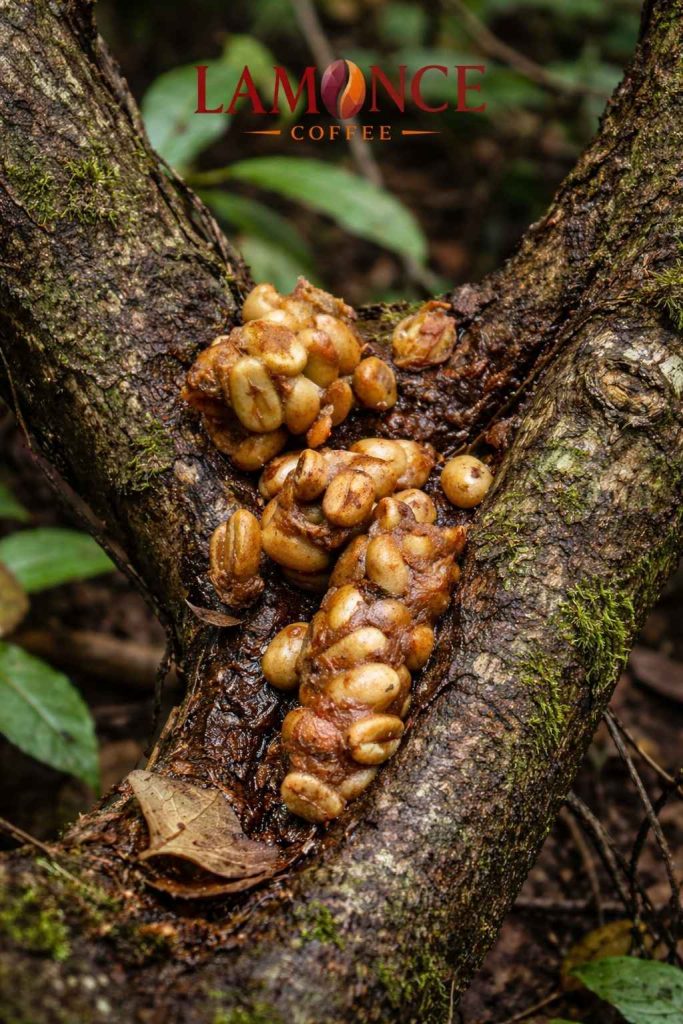
Therefore, Pak Hasan’s eyes are not fixed on the soil, but rather scanning strong transversal tree branches, monolithic rock crevices, and fallen tree logs.
Exactly at 07:00 AM, he spotted a fresh cylindrical mound of feces studded with coffee beans. The harvesting rule at Lamoncecoffee.com is unyielding: the droppings must be collected immediately in the early morning.
“If we are late and collect them in the afternoon, these beans will be severely damaged by direct thermal UV exposure, stolen by opportunistic ground squirrels, or contaminated by toxic mycotoxins from sporadic soil fungi,” Pak Hasan noted, carefully placing the clump into his basket.
Hygienic Processing for World-Class Quality
Once his basket was sufficiently filled from combing through Dispot Linge and Kepala Akal, Pak Hasan returned to the traditional wet mill station. The work was far from over; the organic decontamination relay had just begun.
Coffee beans excreted by wild animals naturally carry commensal bacteria from the carnivorous mammal’s gut, including Escherichia coli. Because of this, absolute hygienic procedures are mandatory.
| Post-Harvest Agrotechnical Stages | Process Description | Primary Objective |
| Static Aquatic Soaking | Soaking the fecal clumps in a water basin for a full 3 hours. | To shed sticky bio-intestinal slime and soften the civet’s digestive residue. |
| Centrifugal Washing | Washing with a continuous, swirling flow of clean water multiple times. | To ensure no trace of soil or external civet secretions remains visually visible. |
| Tarpaulin Sun-drying | Drying under aggressive solar radiation on clean, raised netting beds (off-ground). | To force the coffee core’s moisture level down to a stable 10-12% while destroying the habitats of latent microbial spores. |
| Endocarp Hulling | Peeling and crushing the parchment shield via mechanical friction. | To yield mature, sterile, pale green civet beans ready for the global market. |
The final grand touch to guarantee international consumption safety is roasting. Commercial cylinder roasting at extreme temperatures (approaching 200°C) annihilates the last genetic traces of wild microorganisms. Simultaneously, this extreme heat triggers a storm of Maillard reactions—where the free amino acids produced in the civet’s gut react with reducing sugars—synthesizing a rich vocabulary of thick caramel, malt chocolate aromas that mark a world-class coffee.
Lamoncecoffee’s Commitment: Conservation over Exploitation
At the end of his day, while sipping a cup from last month’s harvest, Pak Hasan always inserts an essential reflection. The extreme valuation of civet coffee, reaching thousands of dollars, has triggered a dark catastrophe in the industry: captive caged civet farming.
For Lamoncecoffee.com and true farmers like Pak Hasan, forcing wild civets into artificial battery cages is a barbaric act.
- Stress and Spatial Deprivation: Caging them steals the hundreds of meters of running routes they use to maintain their territory.
- Quality Destruction: Forcing upon them a depressive mono-diet of coffee causes malnutrition, kills the functional probiotic equilibrium in their stomachs, and destructively castrates the biochemical anomalies that construct the original premium aroma of authentic Kopi Luwak.
“The quality of Wild Luwak Coffee stems purely from the secret biochemical harmonization of the macro-ecosystem and the micro-biological functionality of the solitary animal ,” Pak Hasan affirmed. “Securing the ecological freedom of these mythical seed dispersers in the agricultural border canopy is not just an ethical obligation for animal welfare; it means preserving the universe’s only irreplaceable organic bioreactor.”
Through the dedication of farmers in Dispot Linge and Kepala Akal, and the ethical commitment upheld by Lamoncecoffee.com, every sip of civet coffee served in your cup is not the product of suffering. Rather, it is the liquid gold born of the Sumatran forest’s biological symphony—a natural masterpiece formulated beneath the stars, harvested at dawn, and processed with the highest reverence for the sustainability of human agricultural heritage.